
“Would you like to join me?” I asked my husband. He was startled. He had plans, and I wanted to drive 131 miles one way to see some trees.
“A ginkgo?” he echoed. “Is this a joke?”
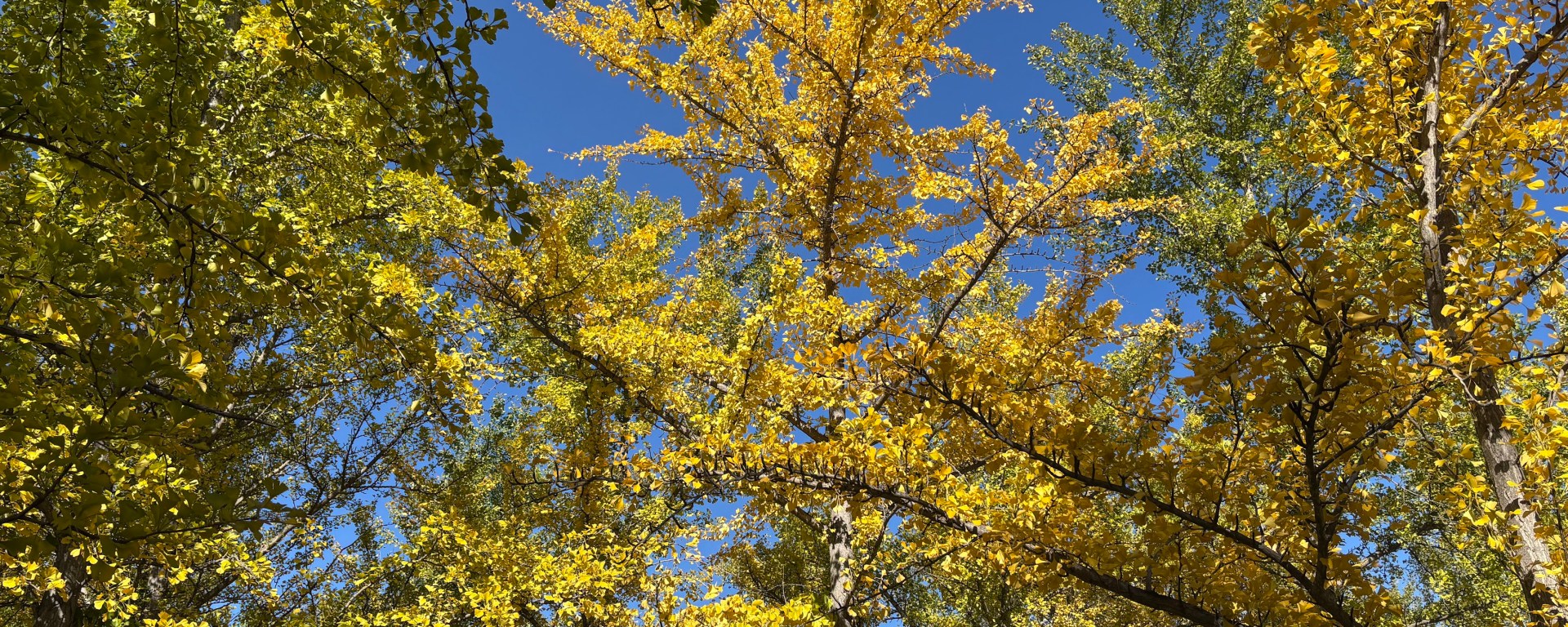
“They are golden,” I replied. “And Blandy has one of the largest, if not THE largest, grove of ginkgoes in North America.” He said he would let me know.
I had almost forgotten about the ginkgoes at Blandy Experiment Station, but last week, when the seasonal change of color finally appeared to be descending upon Richmond, I remembered. I checked the Blandy website and realized that the time had come; the ginkgoes were ablaze. Oddly enough, I had a Monday that was unusually light in appointments, so I moved some items to another day and made plans to slip north.
The Ginkgo Grove at Blandy is the result of an experiment that Dr. Orland White, the first Director, conducted in the 1930s to determine what proportion of ginkgo seeds would develop into male or female trees. Dr. White, along with his students, planted a ginkgo grove using seeds collected from a tree at the University of Virginia. And now, all these years later, over 300 trees stand, with the answer roughly one to one: male to female. Ginkgo trees take 20 years to mature and can live 1000 years, so Dr. White didn’t live long enough to know the answer, but now decades later, the Grove is an invitation to wander and gaze upon the fruits of his labor. Late October and early November are the best times to come, so when I remembered the ginkgoes and saw several days of rain in the forecast, I knew I couldn’t postpone this adventure.

When I was a teenager my mother gave me a pendant made from a ginkgo leaf dipped in gold. Mother had been fond of ginkgoes since her college days at what was then Mississippi State College for Women in Columbus, Mississippi. A gift from Japan in the early 19th century, the ginkgo was said to be one of the oldest trees on campus. The stately golden-leafed tree was a memory she carried with her, planting her own ginkgo tree at our home years later in the Mississippi Delta. In early December, mother would often walk into the house and say, “Have you seen the ginkgoes?” Some days, she would carry one small golden leaf and place it on her bedside table. I wasn’t exactly sure what a ginkgo was, but then she would point out the window to the one she had planted with the fan-shaped leaf, half green, half gold, slowly changing. Gradually, over time, I began to recognize the ginkgo. I didn’t know then what a gift she was giving me. Not simply the pendant, but the knowledge and awareness of the beauty of an extraordinary tree.

Last fall, a friend of mine posted weekly pictures on Facebook of the ginkgo tree she walked by each day. “Keep posting!” I encouraged. And she did. Watching the green turn to gold is so mysterious and beautiful–a transformation before your eyes.

Perhaps that’s what’s so alluring —the simple, subtle transformation, the change that takes place, and with that change invites us all to see something anew. Even now, as I think about the ginkgo, I wonder what change I’m being invited to. What slow, subtle transformation am I in the midst of that will one day be clear? I can’t be certain, but I know it’s there. And I’ll know the beauty of transformation whenever I walk among the ginkgoes.
“Transformation is an ongoing process that tends to appear ordinary, when, in fact, something extraordinary is taking place.”–Suzy Ross

 Florence Brooks
Thank you for this wonderful story, Florence. So many trees offer this fantastic lesson. Cathy and I have a neighbor with twin Maple trees that slowly start with a red tint, and then – HEADFAKE! – turn golden. And, what seems like a minute later, drop all of their leaves. The bark of the maple, with the slightest of rain, turn a chocolate brown, and so the leaves kind of dance around the trunks and branches, as though they are unrelated. Different creatures – one heavy, the other light.
LikeLiked by 1 person
You paint a beautiful story as I imagine the red maple, the transformation, and the movement. Looking forward to seeing you SOON!
LikeLike
Thank you for this wonderful story, Florence. So many trees offer this fantastic lesson. Cathy and I have a neighbor with twin Maple trees that slowly start with a red tint, and then – HEADFAKE! – turn golden. And, what seems like a minute later, drop all of their leaves. The bark of the maple, with the slightest of rain, turn a chocolate brown, and so the leaves kind of dance around the trunks and branches, as though they are unrelated. Different creatures – one heavy, the other light.
LikeLike